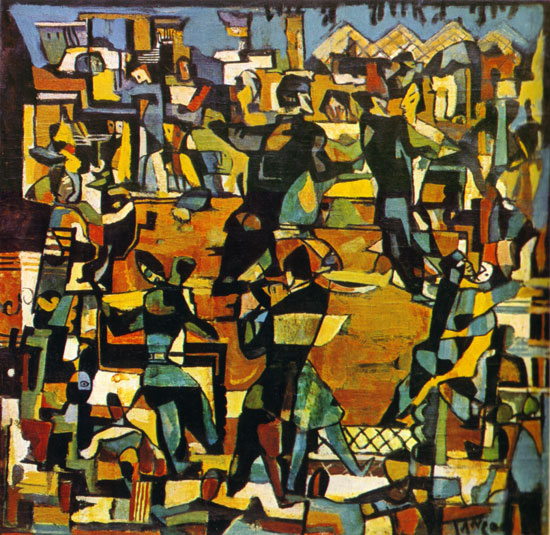
 Dada or Dadaism is a cultural movement that began in Zurich, Switzerland, during World War I and peaked from 1916 to 1922. To quote Dona Budd's The Language of Art Knowledge, "Dada was born out of negative reaction to the horrors of World War I. This international movement was begun by a group of artists and poets associated with the Cabaret Voltaire in Zurich. Dada rejected reason and logic, prizing nonsense, irrationality and intuition. The origin of the name Dada is unclear; some believe that it is a nonsensical word. Others maintain that it originates from the Romanian artists Tristan Tzara and Marcel Janco's frequent use of the words da, da, meaning yes, yes in the Romanian language. Another theory says that the name "Dada" came during a meeting of the group when a paper knife stuck into a French-German dictionary happened to point to 'dada', a French word for 'hobbyhorse." The movement primarily involved visual arts, literature—poetry, art manifestoes, art theory—theatre, and graphic design, and concentrated its anti-war politics through a rejection of the prevailing standards in art through anti-art cultural works. Its purpose was to ridicule the meaninglessness of the modern world as its participants saw it. In addition to being anti-war, Dada was also anti-bourgeois and socialist in nature.
Dada activities included public gatherings, demonstrations, and publication of art/literary journals; passionate coverage of art, politics, and culture were topics often discussed in a variety of media. The movement influenced later styles like the avant-garde and downtown music movements, and groups including surrealism, Nouveau réalisme, pop art and Fluxus.
Dada is the groundwork to abstract art and sound poetry, a starting point for performance art, a prelude to postmodernism, an influence on pop art, a celebration of antiart to be later embraced for anarcho-political uses in the 1960s and the movement that lay the foundation for Surrealism.
—Marc Lowenthal, translator's introduction to Francis Picabia's I Am a Beautiful Monster: Poetry, Prose, And Provocation
Dada was an informal international movement, with participants in Europe and North America. The beginnings of Dada correspond to the outbreak of World War I. For many participants, the movement was a protest against the bourgeois nationalist and colonialist interests, which many Dadaists believed were the root cause of the war, and against the cultural and intellectual conformity—in art and more broadly in society—that corresponded to the war.
Hannah Höch, Cut with the Dada Kitchen Knife through the Last Weimar Beer-Belly Cultural Epoch in Germany, 1919, collage of pasted papers, 90x144 cm, Nationalgalerie, Staatliche Museen zu Berlin
 Many Dadaists believed that the 'reason' and 'logic' of bourgeois capitalist society had led people into war. They expressed their rejection of that ideology in artistic expression that appeared to reject logic and embrace chaos and irrationality. For example, George Grosz later recalled that his Dadaist art was intended as a protest "against this world of mutual destruction."
According to Hans Richter, Dada was not art, it was "anti-art." Everything for which art stood, Dada represented the opposite. Where art was concerned with traditional aesthetics, Dada ignored aesthetics. If art was to appeal to sensibilities, Dada was intended to offend. Through their rejection of traditional culture and aesthetics, the Dadaists hoped to destroy traditional culture and aesthetics.[citation needed]
As Hugo Ball expressed it, "For us, art is not an end in itself ... but it is an opportunity for the true perception and criticism of the times we live in."
A reviewer from the American Art News stated at the time that "Dada philosophy is the sickest, most paralyzing and most destructive thing that has ever originated from the brain of man." Art historians have described Dada as being, in large part, a "reaction to what many of these artists saw as nothing more than an insane spectacle of collective homicide."
Years later, Dada artists described the movement as "a phenomenon bursting forth in the midst of the postwar economic and moral crisis, a savior, a monster, which would lay waste to everything in its path. [It was] a systematic work of destruction and demoralization... In the end it became nothing but an act of sacrilege."

Hiç yorum yok:
Yorum Gönder
Not: Yalnızca bu blogun üyesi yorum gönderebilir.